



FAQs
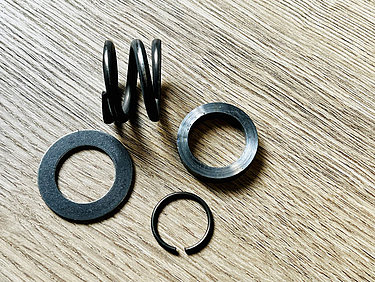
Are spare parts available for HEUER vices?
A HEUER vice usually works for many decades without any significant wear to the installed parts. If you should require a circlip, a compression ring, a pressure disc or a compression spring at any time, we will be happy to provide these small parts free of charge. Please send details of the jaw width and spindle diameter together with your postal address to sales@heuer.de.
What is the purpose of protective jaws on the vice?
Our magnetic protective jaws have several advantages and functions. They mainly serve to protect the clamped workpiece. If you wish to clamp sensitive objects made of wood, aluminium or stainless steel in the vice, for example, you should choose protective jaws of type G (aluminium with rubber), type Fi (aluminium with felt) or type PR (polyurethane with chequering).
For round or oval workpieces, we recommend jaws of type P (aluminium with prisms) and PP (polyurethane with prisms).
All protective jaws from Brockhaus Heuer have a powerful round magnet on the back. This is press-fitted firmly into the jaw profile and thus fixed permanently in place. In comparison, some of the protective jaws on the market have an adhesive magnetic strip. These usually do not last for long, since the adhesive disbonds over time.
Click here for an overview of all protective jaws for vices.
How much clamping force does a vice have?
The clamping force depends on different factors which characterise the different vices:
» Material (steel, grey cast iron)
» Manufacturing process (forging, casting, welding)
» Size of the vice
» Opening width of the vice
» Length of the spindle key
In the case of the material, a distinction is mainly made between two different types: steel and grey cast iron. The manufacturing process follows from this. Forged vices are usually made of steel, cast vices of grey cast iron.
Forging has an optimum influence on the microstructure of steel since the lines are homogeneous. Thus the material has very high yield points and proof stress, and the vice can absorb even more forces. The disadvantage of vices made of grey cast iron is often that the manufacturing process makes the material brittle, since air can become trapped in so-called blowholes during manufacturing. Vices made of this material require a significantly higher mass to absorb comparable clamping forces. These models often have a smaller jaw width and a smaller span width. The spindle key is also usually shorter, since the clamping force exerted on the vice is influenced to a major extent by the corresponding lever action.
HEUER vices are forged from steel and guaranteed unbreakable. The smallest model with 100 mm jaw width has a clamping force of 1.5 tonnes, the 120 mm model has 3 tonnes, the 140 mm vice has 3.5 tonnes and the two top models 160 mm / 180 mm have a powerful 4 tonnes.
Find out more about our commitment to quality.
How is a vice fixed to the workbench?
The vice must be placed on the workbench in such a way that the clamping face of the fixed rear jaw protrudes vertically above the front edge of the workbench. This is the only way to make full use of the advantage of the large side clamping depth possibility for clamping long workpieces vertically in front of the workbench. Where possible, through bolts with nuts should be used for fixing the vice. The bolt holes must be marked carefully and drilled about 2 mm larger than the bolt diameter. The bolts must not be forced or become canted during insertion through the vice and workbench. At the start of installation, the two clamping faces of the vice must be screwed together tightly. Before attachment and tightening of the bolt nuts, particular care must be taken that the vice is not wobbly but is flush to the workbench surface. The four attachment bolts must be tightened cross-wise and evenly, particularly if the vice is being fixed to a softer base (e.g. wood). If the vice is strained or canted by not being completely flush to the base or through uneven tightening of the attachment bolts, it will be stiff and jerky to use and there will be a one-sided load on the guides.
How heavy is a vice?
The weight of a vice depends on the size, the material used and the manufacturing process. HEUER vices are forged from steel and can thus absorb high forces despite their slim design. Thus the smallest HEUER vice with a jaw width of 100 mm and weight of 4.5 kg has a clamping force of 1.5 tonnes. The largest model weighs 29 kg and has a clamping force of 4 tonnes. In comparison, vices made of grey cast iron usually weigh significantly more despite their smaller jaw width, since the material structure cannot absorb such high forces, making more mass necessary.
Click here for the data sheet with all the technical information at a glance.
What size should a vice have?
Vices are usually distinguished on the basis of their jaw width, in other words, the width of the clamping jaws from left to right. HEUER vice models are available in widths from 100 mm to 180 mm. Alongside the jaw width, the opening width (span width) of the vice is also crucial, because the vice should of course open far enough to be able to clamp the workpiece safely. The span width of HEUER vices is between 125 mm and 225 mm depending on the model.
Click here for the data sheet with all the technical information at a glance.
Where are HEUER vices manufactured?
HEUER vices are manufactured exclusively in Germany. After Josef Heuer sold his vice patent to the company Brockhaus Söhne in 1927, production started immediately in Plettenberg-Oesterau. This is still the manufacturing site today, although the company is now called Brockhaus Heuer GmbH.
You can find films about our company and the production line on our "Film page".
What materials are used to manufacture HEUER vices?
HEUER vices are forged from C45 steel. In the case of forged steel, the material structure has advantageous properties compared to other materials and processes (e.g. grey cast iron).
Forged vices usually have a much slimmer design and yet they can still absorb enormous clamping forces.
Which is why we can guarantee that HEUER vices are unbreakable!
Click here for further product details.
Which vice and which accessories are most appropriate for my application?
Vices are traditionally distinguished on the basis of their jaw width. HEUER vices are available with jaw widths of 100, 120, 140, 160 and 180 mm. The larger the jaw width, the larger the span width (opening width) and of course the weight of the vice (4.5 to 29 kg).
Depending on the application, the use of separately available accessories, such as a rotary table or magnetic protective jaws made of aluminium, can be advisable.
You can enter information about the workpiece, tasks and space available in our product configurator to get a customised suggestion for a product that is tailored to your needs.
Where can I buy HEUER vices and accessories?
We mainly sell our products through specialist tool dealers. Some of our dealers have their own online shops or sell through Amazon. If you wish to buy the product locally in a shop, we recommend that you ask the dealer about availability first, because not all dealers have all the HEUER vice variants and accessories in stock. Please contact us if you need help with locating a dealer. To the contact form
Alternatively, you can order directly from our vice shop.
How long is the warranty on HEUER vices?
The statutory warranty period is 2 years. However, the service life of HEUER vices is usually much longer, with them often being passed on to future generations.
HEUER vices are made of forged steel and guaranteed unbreakable!
Visit the field reports section to find out more about the experiences made by other vice users.
If there should ever be a problem with your HEUER vice, we will be happy to help.
My vice does not open smoothly / the jaws burst open. What can I do?
If the vice jolts and jerks during opening, this is not usually a fault, only a warning sign that the guide is too stiff. This could be due to one of the following reasons:
a) The vice became canted during mounting
b) The guide is heavily soiled or not oiled
c) The guide is set too tight
The problem can usually be solved quickly and easily.
Watch the video to see what work steps are necessary for your HEUER vice to work smoothly again.
Do current accessories fit the old HEUER vices with 90, 115, 135, 150, and 175 mm jaw width?
The jaw width for HEUER vices was changed in 1996:
90 became 100 mm
115 became 120 mm
135 became 140 mm
150 became 160 mm
175 became 180 mm
We made sure that the hole dimensions in the base of the vice were not changed, so that an old HEUER vice can also be used with current accessories e.g. rotary plate or height adjustment. Equally, a new vice can be mounted on an old rotary plate.
To be sure, we recommend that you compare the dimensions on the basis of the current data sheet.
What type of paint is used to coat HEUER vices, and can this paint be purchased later on?
Our products are powder-coated. This type of coating is environmentally friendly and durable. An electrostatic cloud of powder is produced and transported to the workpiece. The powder sticks and forms a closed coat of paint on the product. It is then baked at approx. 200 °C.
The shade "Hammerschlag Blau" is a customised mixture for Brockhaus Heuer. If you wish to touch up the paint on your vice, we recommend the colour "RAL 5009 azure blue".
By the way: the original colour of the HEUER vices manufactured in the first few years (from 1927) cannot be found in the brochures published at the time, because they were not printed in colour. However, the original colour was able to be determined using a HEUER Primus / DRP vice: it was a light grey colour with a touch of blue, something close to RAL 7001 silver grey.
I have inherited a HEUER vice. How can I find out when it was produced?
In most cases, the production year was stamped in the slide rail. But the shape of the vice also provides clues about the production period.
You are welcome to have a look at our "How old is my vice" page, where all our vice models are listed together with their year of manufacture. Or send us a photo of your vice and we will help you with the research!
There are significantly cheaper vices available at DIY markets and discounters. What is the reason for this price difference?
We believe that tools should be bought to last for many years or even decades. HEUER vices are sturdy, safe, reliable, precise, powerful and extremely durable. Only the combination of all these criteria results in a perfect tool for you.
Read more on the Our commitment to quality page.
It is not uncommon for a HEUER vice to survive several generations and be passed on from one to the next. You will find field reports on our Field reports page.
Everyone has probably learned their lesson about buying cheap tools. There's plenty of truth behind the saying "If you buy cheap, you buy twice!".
You can of course clamp a workpiece in place using a vice from Asia costing 20-50 Euros. The question is how long it will last and how precise the result is.
The higher purchasing price of a high-quality brand product "Made in Germany" is then quickly put into perspective.


How do you set the optimum working height on the vice?
Adaptation of the vice to your own height is especially important in order to avoid serious posture damage. During many tasks that are carried out at the vice, a HEUER LIFT height adjustment device also makes your work much easier.
The height of the vice can be adjusted easily, safely and gradually by up to 200 mm.
A gas spring matched to the weight of the respective vice makes the vice more or less weightless, so that it can be moved to the required work position with little effort after the clamping lever has been released. In addition, the vice can be turned through 360° and can be fixed in every position using the safety clamping lever.
Click here for an overview of optimum working height.
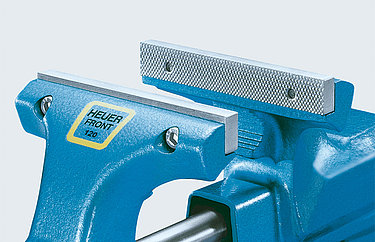
Why do some vices have replaceable jaws, and what is the advantage of this model?
Originally, replaceable jaws were only available for cast vices, because grey cast iron cannot be hardened. Replaceable jaws were not really necessary for forged steel HEUER vices, because the forged steel could easily be hardened. Nevertheless, in 1979, Brockhaus started producing the HEUER vice with replaceable jaws.
These surface-hardened jaws have one chequered and one smooth side. They are reversible and replaceable. The threads are integrated in the replaceable jaws. Thus if the clamping jaws become damaged, the valuable vice itself will still be able to be used.
If the vice is often used for sawing, welding or flexing work, we recommend investing that little bit more for this special model when buying your vice.
The vice with replaceable jaws has the same basic design as the standard version. Click here for the data sheet for the HEUER vice with replaceable jaws.
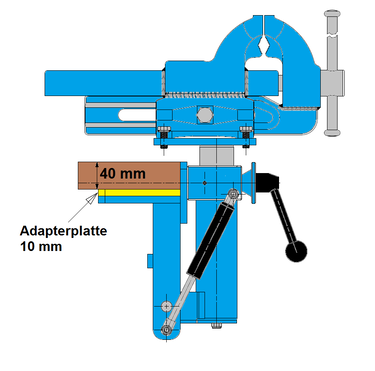
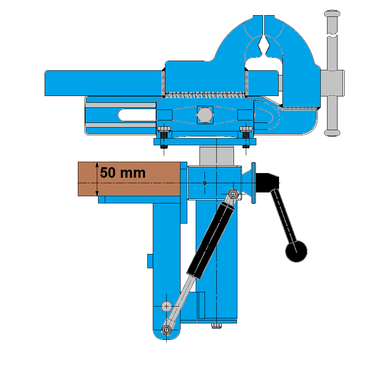
My workbench top is 40 mm thick. Can I still fit a Collapsible-Lift device?
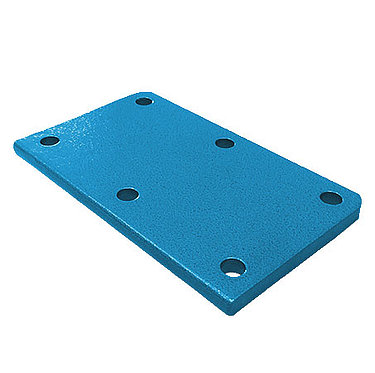
The Collapsible-Lift device has been designed for workbenches tops with a thickness of 50 mm as standard. For attachment to a 40 mm workbench top, a plate must be inserted to compensate the difference. We have an adapter plate in our range for this, which can be ordered separately (art. no. 702727).
How can a HEUER vice be restored?
The restoration of a HEUER vice usually includes the following work steps:
- Dismantling
- Paint stripping (through chemical paint stripping, sandblasting, sandpaper or a wire brush)
- Cleaning
- Touching up of minor damage to the material, smoothing of the edges
- Masking of the guide surfaces
- Priming
- Application of a new coat of paint
- Assembly
In the following film you can watch the restoration of a size 150 HEUER vice: To the film
